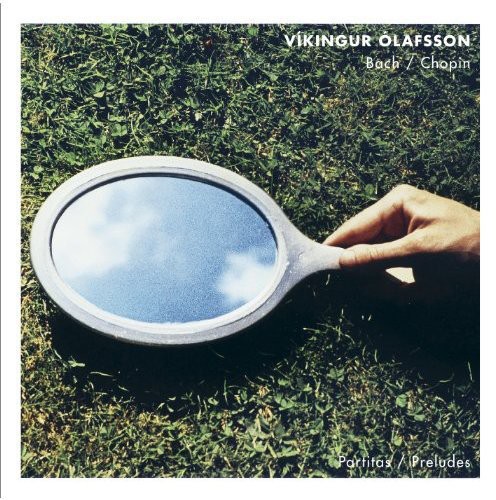

Vikingur Olafsson: Chopin-Bach
Currently Unavailable
About This Release
CHOPIN 24 PRÉLUDES AND BACH'S PARTITAS 2 AND 5 NOTES BY Vikingur Olafsson c LATE NIGHTS IN PARIS Chopin does not derive his satisfaction from the fact that his hands are applauded by other hands for their agile dexterity, he aspires to a greater success; his fingers are the servants of his soul, and his soul is applauded by those who do not merely listen with their ears, but also with their souls. H. Heine All sources agree that Frédéric Chopin was one of the true improvisatory geniuses in the history of music. One can easily imagine the evenings of the 1840's and 50's when the aristocratic parties in Paris ended with Chopin seated at the piano, unleashing his extraordinary musical powers in the presence of some of the greatest artists of the time: Franz Liszt, Hector Berlioz, Eugène Delacroix, Heinrich Heine and George Sand. In his memoirs of Chopin, Berlioz describes these evenings: 'A small circle of select listeners, whose real desire to hear him was beyond doubt, could alone determine him to approach the piano. What emotions he would then call forth! What ardent and melancholy reveries he loved to pour out his soul! It was usually towards midnight that he gave himself up with the greatest abandon, when the big butterflies of the salon had left, when the political questions of the day had been discussed at length, when all the gossips had exhausted their supply of stories.' Berlioz' account is in accordance with those of others. The French poet Ernest Legouvé remarked that Chopin was a good pianist till midnight - when he turned magnificent. But even though he had seemingly unlimited access to divine inspiration late at night, Chopin meticulously studied every detail of his works by day. One of his pupils, Josef Filtsch, wrote in a letter to his parents: 'The other day I heard Chopin improvise at George Sand's. It is marvellous to hear him compose in this way; his inspiration is so immediate and complete that he plays without hesitation, as though it had to be thus. But when it comes to writing it down and recapturing the original thought in all it's details, he spends days of nervous strain and almost frightening desperation. He alters and retouches the same phrases incessantly and walks up and down like a madman.' Although he was one of the most famous pianists of his day, Chopin preferred playing for small groups of friends, and only gave about 30 public recitals in his life. He once confided in a student that in his view, concerts never created real music. They were a form that one needed to dispose of in order to reach the most beautiful in art. When announcements were made about Chopin's recital in Paris in 1841, his lover George Sand wrote to her friend: 'This Chopinesque nightmare will take place in Pleyel's Salons on the 26th. He doesn't want any posters, he doesn't want any programmes, he doesn't want anyone to talk about it. He is afraid of so many things that I have suggested he play without candles, without and audience on a mute piano.' The story goes that Chopin didn't reach a state of calm until he had retired to his study and played some fugues from Johann Sebastian Bach's Well-Tempered Clavier. CHOPIN AND BACH Chopin derived limited compositional inspiration from his contemporaries. At the dawn of great, epic symphonies when the likes of Liszt, Schumann and Berlioz could unite in the ideology of program music - composing instrumental music around particular themes or narratives - Chopin focused exclusively on works of all types for piano, except programmatic ones. The influence of Bellini's bel canto style is obvious in Chopin's work and so is the stylistic serenity of Mozart. However, it can be argued that it is in Bach's practice of polyphony and chromaticism that Chopin's art is most firmly rooted. Bach's music was in vogue after being revived by Mendelssohn's performance of the St. Matthew Passion in 1829. While the classical composers had been influenced by his works, they had never entered concert repertoire. In the aftermath of the famous revival, a mini "Bach-craze" shook the music world, Liszt made piano transcriptions of Bach's works while Mendelssohn wrote preludes and fugues. However Chopin arguably incorporated Bach's qualities most effortlessly into his own, distinctive style. Even with all it's abundance of inspired melodies, Chopin's music is always contrapuntal: even the simplest melodic accopaniments are elevated to refined organisms of polyphonic complexity. And he intended for them to be played thus, imploring his piano students to lend the inner voices the same singing rendition as the leading melodies. His knowledge of Bach's music was also of a scholarly nature. In his free time he not only played the fugues from the Well-Tempered Clavier for his own well-being but also corrected editions of it "not just the engraver's mistakes, but also passages accepted by those who claim to understand Bach (not because I pretend to understand him better, but from a feeling that perhaps I can sometimes guess right)."5 Furthermore it is difficult to imagine the wild chromatic harmonies which make for some of Chopin's most captivating moments without his acquaintance of Bach's incomparable, progressive treatment of chromaticism. In some of Chopin's late works, there are moments when harmonies are juxtaposed so adventorously that the music seems to approach a harmonic no man's land, almost unaffiliated with any key whatsoever. Under Bach's influence, Chopin approached the boundaries of tonality, which was later to be stretched yet further by Richard Wagner and Claude Debussy. 24 PRELUDES IN 24 KEYS Valldemosa, between the mountains and the sea, a huge abandoned Carthusian monastery, where in a cell with doors larger than any pair of gates in Paris, you can imagine me, my hair uncurled, without white gloves, pale as ever. The cell is in the shape of a tall coffin, with great dusty vault, a small window, and, outside oranges, palms, cypresses. Opposite the window, my bed of straps, under a Moorish filigree rose. Next to my bed there is a hopeless square desk I can hardly write on, on it a leaden candlestick (a luxury here) with a candle in it, my Bach, my own scrawls, someone else's papers ... silence ... you can yell ... silence still. In a word, it is a strange place I am writing from. These lines were written by the gallant Chopin - a sophisticated man of the world, not unfamiliar with life's pleasures, renowned for his glove collection and immaculate attire - in a letter to a friend from Mallorca, dated 1838. The purpose of the stay was therapeutic but it turned into quite a misery, the weather was dreadful and Chopin's health deteriorated sharply. Even in the most spartan of facilities, Bach's music wasn't far away and it was here that Chopin finished his 24 preludes. The title and the format - one prelude for each musical key - indicates an indisputable connection with Bach's two sets of 24 preludes and fugues in all keys. The form of the prelude dates back to lute compositions of the Renaissance period. Preludes functioned as short appetizers before longer, more substantial works and served the lute players as a means of testing their instruments and the acoustics before the actual concert commenced. From the outset the prelude was intrinsically improvisatory and unpredictable. From the early stages of his career, each new work of Chopin's was awaited with anticipation. Still in his late twenties, he had already created the ballade as an instrumental form and reinvented - and elevated - older forms such as the etude, nocturne and mazurka. He redefined everything he touched in those years and it is safe to assert that few could have predicted what the new set of preludes was to present. Many of them are very brief, the shortest one (Nr. 7) is only sixteen measures in total. Indeed, around half of the preludes last for less than a minute each, and some (11 and 14) can be described rather as hints of an emotion then ful
Tracklist
1
Partita No. 5 In G Major, Bwv 829: I. Preambulum
2
Partita No. 5 In G Major, Bwv 829: II. Allemande
3
Partita No. 5 In G Major, Bwv 829: III. Corrente
4
Partita No. 5 In G Major, Bwv 829: IV. Sarabande
5
Partita No. 5 In G Major, Bwv 829: V. Tempo DI Minuetta
6
Partita No. 5 In G Major, Bwv 829: VI. Passepied
7
Partita No. 5 In G Major, Bwv 829: VII. Gigue
8
Partita No. 2 In C Minor, Bwv 826: I. Sinfonia
9
Partita No. 2 In C Minor, Bwv 826: II. Allemande
10
Partita No. 2 In C Minor, Bwv 826: III. Courante
11
Partita No. 2 In C Minor, Bwv 826: IV. Sarabande
12
Partita No. 2 In C Minor, Bwv 826: V. Rondeaux
13
Partita No. 2 In C Minor, Bwv 826: VI. Capriccio
14
24 Préludes Op. 28: No. 1 In C Major
15
24 Préludes Op. 28: No. 2 In A Minor
16
24 Préludes Op. 28 - No. 3 In G Major
17
24 Préludes Op. 28: No. 4 In E Minor
18
24 Préludes Op. 28: No. 5 In D Major
19
24 Préludes Op. 28: No. 6 In B Minor
20
24 Préludes Op. 28: No. 7 In A Major
21
24 Préludes Op. 28: No. 8 In F Sharp Minor
22
24 Préludes Op. 28: No. 9 In E Major
23
24 Préludes Op. 28: No. 10 In C Sharp Minor
24
24 Préludes Op. 28: No. 11 In B Major
25
24 Préludes Op. 28: No. 12 In G Sharp Minor
26
24 Préludes Op. 28: No. 13 In F Sharp Major
27
24 Préludes Op. 28: No. 14 In E Flat Minor
28
24 Préludes Op. 28: No. 15 In D Flat Major
29
24 Préludes Op. 28: No. 16 In B Flat Minor
30
24 Préludes Op. 28: No. 17 In A Flat Major
31
24 Préludes Op. 28: No. 18 In F Minor
32
24 Préludes Op. 28: No. 19 In E Flat Major
33
24 Préludes Op. 28: No. 20 In C Minor
34
24 Préludes Op. 28: No. 21 In B Flat Major
35
24 Préludes Op. 28: No. 22 In G Minor
36
24 Préludes Op. 28: No. 23 F Major
37
24 Préludes Op. 28: No. 24 In D Minor